A Visit to the Concertgebouw (and the joys of Dutch queuing)

Ciao Readers!  And Happy Birthday Honey!!!  (and Michelangelo back in 1475)

Today I am taking you to one of the great concert halls of the world – The Concertgebouw in Amsterdam.  And, as an added bonus, we’ll get to attend a free lunchtime concert (offered every Wednesday at 12:30 from September until June).  The construction of this lavish hall began with an idea in 1881 and culminated with its grand opening in 1888.  It is considered to have some of the best acoustics in the world – usually ranked among the top three music halls worldwide.

The Concertgebouw is home to the Royal Concertgebouw Orchestra, also considered to be one of the world’s best orchestras.  Oftentimes (like the first time we visited), the free Wednesday concerts are short practice runs for the orchestra’s full-blown evening concerts taking place the same week.  Sometimes (as we learned on our recent trip), the concerts are completely free-standing venues for new and upcoming artists.  But before we get to enjoy the concert, there’s the matter of that long line out front….

When we got to the hall at about 12:00, the line was already ridiculously long (sorry I didn’t take a photo) and it was about 30 degrees out (from extrapolation of seats available [a little over 2,000], there were at least 1,000 people in line before us).  Now, I guess I have become jaded from Italy, because upon seeing the line I immediately assumed it would take us hours to get through, people would be pushing and shoving and cutting (and I’d likely get my broken toe stepped on in the process), and we’d never get through the line fast enough to make the 12:30 concert.  I was discouraged and suggested we just give up; Steve, who is more patient than I, suggested we wait it out a few minutes and see what happens, which we did.  And lo and behold, about 10 minutes later they opened the doors…and literally about 3 minutes after that we had all filed into the hall in an orderly fashion and were taking our seats!  I think I was so excited about how fast and orderly the line went (and how unscathed we were) that  it took several minutes for me to begin to look around and appreciate how amazing the hall itself is.

Okay, now that we’re in our seats we can enjoy the concert.  While we just showed up knowing it was a free concert day, we had no idea what concert it was.  While we were expecting a practice run for Bach or Beethoven, we actually stumbled upon a full-blown performance of the group Jazzmania Big Band – performing music from various crime movies and t.v. shows.  It was pretty unexpected, especially considering the surroundings, as you’ll see below, but was a great time.  Here’s the playlist from the concert:

  • Newborn – Theme from The Naked Gun
  • Mancini – Theme from Peter Gunn
  • Shumann – Theme from Dragnet
  • Barry – Theme from James Bond
  • Barry / Bricusse – Goldfinger
  • Theard – Let the Good Times Roll

Now, just imagine that music playing as you sit and enjoy from your seat in this amazing hall (photo of outside courtesy of the Concertgebouw website):

Concert hall

Thank you, as always, for letting me be your tour guide!

Ode to Van Gogh (and the Orsay)

Ciao Readers!

I was trying to decide whether to do a separate post on the Orsay Museum in Paris and the Van Gogh Museum in Amsterdam, and realized it’s all about Van Gogh to me, so I’ve decided to combine the two (plus I have no pictures from inside the VG museum).  I’m not sure I can articulate the reasons why, but Van Gogh is my all-time favorite artist.  His paintings just speak to me.  I like him so much I have waited in line for an hour in Albuquerque to see a single tiny Van Gogh on temporary display, and have been to the Orsay twice and the Van Gogh Museum in Amsterdam three times (well, to be accurate, on this trip the Van Gogh Museum was temporarily housed in the Hermitage Museum as the actual museum is undergoing renovation).  So, do you get how much I dig him?  I even brought back a puzzle from the VG museum so I could continue to enjoy the experience!  (If you’d like to read more about Van Gogh, who failed to sell a single painting while alive and committed suicide in 1890, here’s a link.)

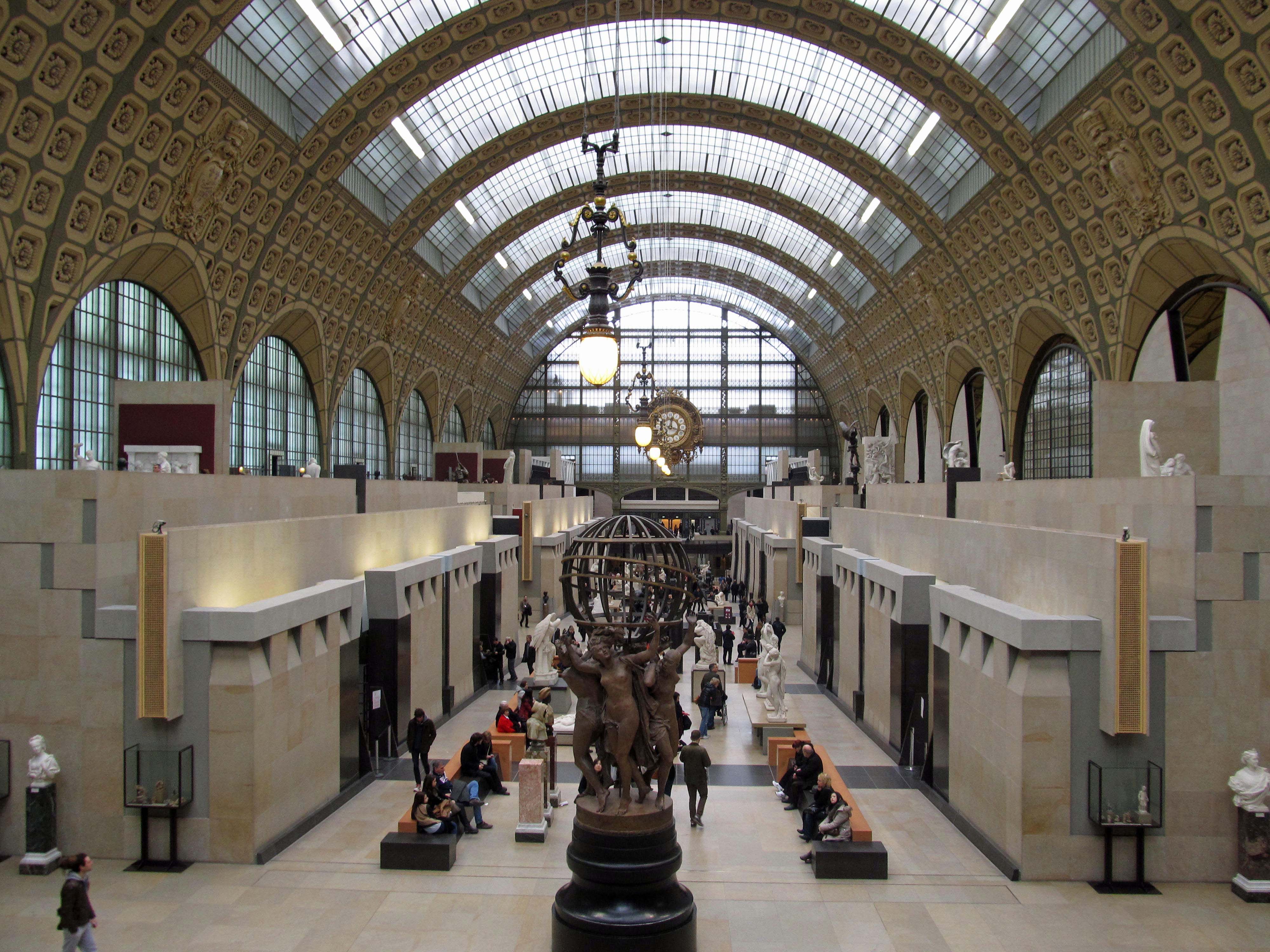
Before we get to the Van Gogh Museum in Amsterdam, though, we need to take a trip to the Orsay in Paris (Musée d’Orsay to be precise).  Not only because it has a decent Van Gogh collection itself, but because to my mind it is one of the nicest museums in the world (well, the parts of the world I’ve seen).  Why is the Orsay so great, you ask?  I’ll tell you.  First off, it’s beautiful.  Take a look from the outside, and then inside from the 2nd floor balcony:

the orsayinside orsay

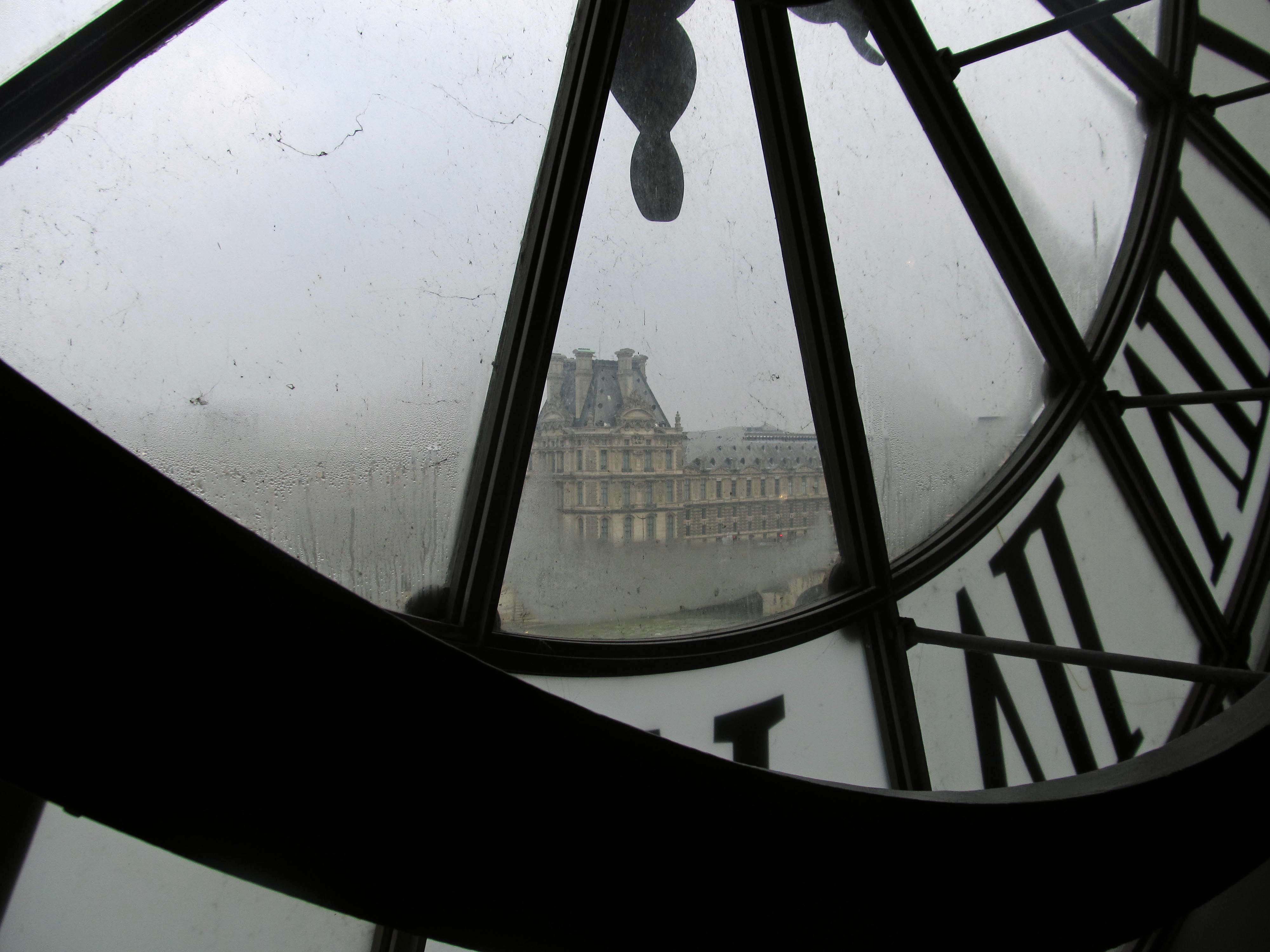
The Orsay used to be a massive train station (complete with fancy hotel) that became obsolete back in the 1930’s (though the hotel remained open) and was scheduled for demolition back in the 1970’s.  However, some bright person(s) in the French Museum Directorate had the idea to collect all of the art from the 1800’s displayed throughout the city and house it here (keeping the restaurant from the fancy hotel and adding a casual cafe to boot).  Great idea!  The Orsay opened as a museum in 1986, with the beautiful clock from the train station remaining as the focal point of the museum….

orsayclock2paris through orsay clock

Not only is the museum beautiful, but it is well-arranged and the art is well-lit (often by natural light).  This stands in stark contrast to some of the museums here in Florence (especially the Uffizi), where you have to squint to see the art in extremely low light.  In addition to being wonderful to look at on its own, its art collection is the largest in the world focusing on impressionism and post-impressionism – my two favorite art periods!  Here you can find masterpieces by many familiar names, including Monet, Manet, Degas, Renoir, Cézanne, Pissarro, Seurat, Gauguin, Rodin, Whistler and, of course, Van Gogh.  I can’t say enough about what a worthwhile experience a day at the Orsay is.

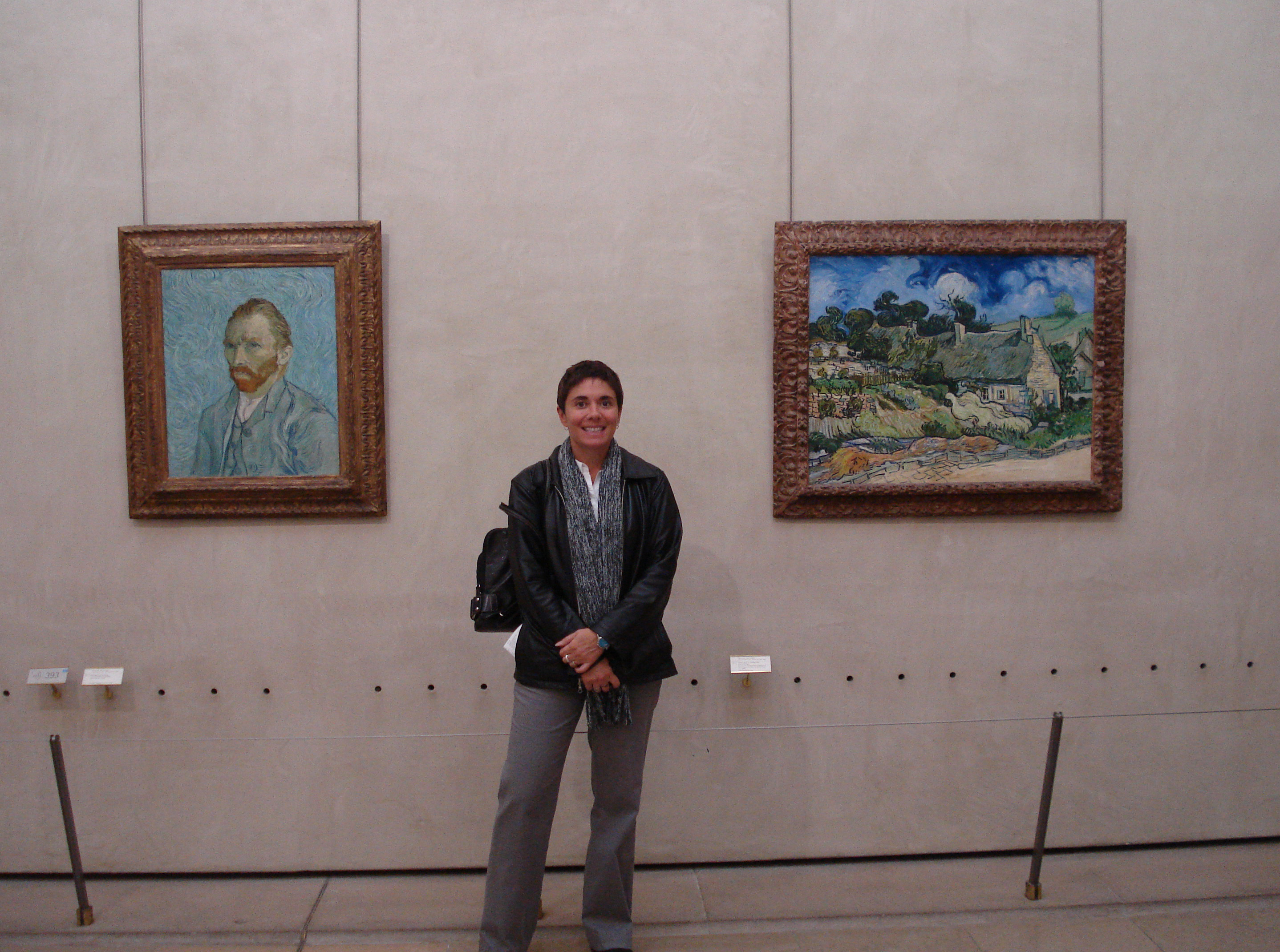
As this time the “no photos” signs were very pronounced, and I didn’t want to risk getting kicked out, I can only share a picture of me and two of the Van Goghs taken here in 2008 (this was shortly after I unwittingly had my head nearly shaved at a salon in Barcelona):

hope and vangogh

As for the Van Gogh Museum in Amsterdam, it is what its name implies – the largest collection of Van Gogh paintings anywhere (he was Dutch after all).  The actual museum, which is under renovation, is a modern marvel and not only houses Van Gogh, but some impressionist and post-impressionist paintings of his friends and contemporaries (for example, Gauguin, who lived with Van Gogh for a bit until Vincent chased him with a razor blade).  While not everything is on display at the temporary location, the Hermitage Museum, we were pleasantly surprised at what a nice job they did basically recreating the Van Gogh section of the actual museum.  We walked the entire museum very slowly (only partly because of my toe), and then just for good measure went back to re-admire some of our favorites (including works inspired by Japanese paintings).  If you like Van Gogh, or think you might, I would definitely put this museum on any “must see” list!

Thanks for coming along on the museum tours!

A Trip to Pisa (complete with kitchy leaning tower photo)

Ciao Readers!

Today I am taking you on a trip to Pisa.  And, as a very special treat, I am taking you on a sunny day (yay!).  We took this trip the Saturday before last in order to catch the Kandinsky exhibit there before it was over.  Of course we weren’t going there to do the cheesy tourist thing and see the leaning tower – we were going there for intellectual/artistic pursuits.  But ya know what…the leaning tower is cool!  And the Kandinsky exhibit…not so much.

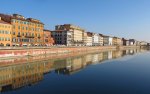
Pisa is about an hour train ride from Florence and also sits on the Arno river (so the photos of the buildings along the Arno may have a familiar look to them).  Since you can read more about it online, and I took a ton of photos since it was finally sunny out, I’ll just point out the highlights of our trip.

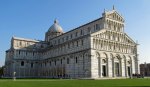
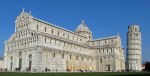
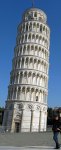
As with many of the smaller cities in Italy, Pisa was pedestrian friendly, though it didn’t have quite the charm of Lucca (it has a large University, so more of a college town).  The famous leaning tower sits in a piazza with several other buildings, including the Duomo (cathedral), pictured.  Entry to the church (unlike the other buildings) is free, though you can’t just enter – you have to walk across the piazza to the ticket office to get a free ticket (it wouldn’t be Italy without some unneccessary hoops to jump through).  The inside of the church is amazing, as with most old churches in Europe (I commented to Steve how the first time we saw one it was awe-inspiring, but now that we’ve seen at least 20….).  The tower itself (started in 1173, completed in 1350 though it had already begun to lean) is very cool.  I’m not sure how it looks in the photos, but in person, it doesn’t look a little tilted – it looks like it might fall over at any moment!  (It was actually closed for a time in the 90’s so it could be stabilized).  And, what visit to the leaning tower would be complete without an obligatory photo of me pretending to hold it up?!

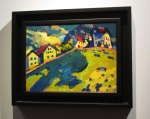
We stayed and enjoyed the piazza and took a walk along the Arno as this was the first sunny day we’d had the pleasure of experiencing in…. (so long I forget).  We enjoyed a typical leisurely Italian lunch and when it started getting later/cooler, we decided to head to our original destination – the Kandinsky exhibit at Palazzo Blu (pictured).  Honestly, it was the anti-highlight of our trip.  First off, the museum was hot (while Italians have an aversion to air-conditioning, they have no such aversion to heaters) and packed with tour groups blocking most of the artwork.  Also, while there were a few pieces we found interesting (pictured), the truth is….  Have you ever been to a museum and you know the art is famous and you know you should be impressed and “understand” it, but what you’re actually thinking is “really?!?!?! any 5 year-old could have done this” – it was like that (my apologies to any hardcore Kandinsky fans).  (I would have taken photos of some of those, but as usual, I got yelled at taking pics [though I actually thought it was permitted].)

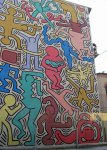
The more interesting piece of art we got to see was a mural (“Tuttomondo”) by Keith Haring, painted in 1989, just a few months before he died in 1990.  We had no idea before going to Pisa and looking at our tourist map that it was there, so it was a nice surprise ending to our visit!

Since the sun was out I went a little bit photo happy….enjoy!

Venice, Part II (The Peggy Guggenheim Collection)

Ciao Readers!

Today we continue our trip to Venice, specifically to the Peggy Guggenheim Collection.  As I mentioned, we’ve actually been to Venice twice before (before we moved to Italy), but for some reason this museum managed to escape my attention.  Just when I was pretty sure I’d have to wait for a trip to France to see any art produced post-1600, I discovered this oasis of modern art!

Now, if you’re like me, you may have a vague sense of the name “Guggenheim” and be thinking “isn’t there a Guggenheim museum in…..?”  If you’re more art-savvy, you already know that there are in fact Guggenheim museums in New York, Berlin, and Bilbao, Spain.  You may even know that there have been other Guggenheims that have closed (e.g., Las Vegas), and yet others in construction (Abu Dhabi).  As usual, because you can Google this yourself, here’s the short version: The Guggenheims were an über-rich family (made their money in mining and smelting) of Swiss/Jewish ancestry.  With lots of that money they became serious patrons of the arts.  Solomon Guggenheim started the foundation that now runs all of the museums…. which brings us to Peggy Guggenheim and her collection in Venice.

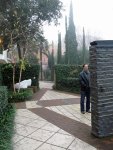
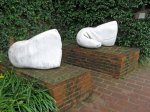
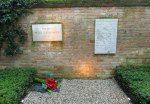
Solomon was actually Peggy’s uncle (interesting fact, Peggy’s father Benjamin went down with the Titanic).  Peggy was an eccentric socialite and art collector who decided to settle down in Venice in 1949, after her divorce from surrealist painter Max Ernst.  She lived out her days there (until 1979) with her art and many dogs (who are buried next to her [see grave picture below]).  That home is now a museum (run by the Solomon Guggenheim Foundation), filled with all of the (modern) art Peggy collected.  It’s pretty mind-blowing that this “museum” and its contents were just one person’s house and stuff!  As you’ll see in the pics, there are Picassos (larger of the two pictured), a Chagall, a Dalí (I love Dalí), a Kadinsky, and many others not pictured (Pollocks, Mirós, Ernsts, a Warhol, and more).   In addition, there’s a very cool garden with some strange sculptures (a G-rated one [I think] is pictured) as well as the actual burial place of Peggy and the aforementioned dogs.  (There’s also a “wish tree” donated by Yoko Ono in 2003.)

Aside from the art and the garden, the other surreal part of the experience was that you really have no idea you are in Venice, Italy.  When we approached the ticket counter, all 3 ticket-takers were speaking English to each other (in English accents), and much to our surprise, all of the arts’ explanations were written first in English, then in Italian.  The museum’s docents had buttons reading “Ask Me About the Art” (in English).  It felt like we stepped through some secret portal to another (English- speaking) country.  Weird.  In any case, we had a great time in this little secret oasis of modernism in an otherwise ancient city.  Thanks for coming along!

The “Gaudí” House

Ciao Readers!

Now, you may be wondering “what does Gaudí have to do with Florence?”  Or, you may be wondering “who the heck is Gaudí in the first place?”  In either case, I shall explain.   Today I am going to give you a peek at my favorite architecture in the world (which I discovered in Barcelona, Spain), through a house right down our very own street.

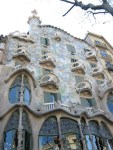
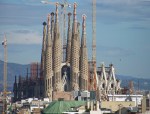
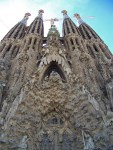
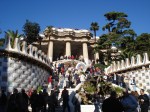
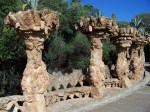
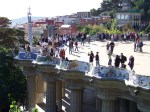
Since you can Wikipedia or Google him yourself, I’ll give you the short version – Antoni Gaudí was a Spanish/Catalan Architect (and visionary) who lived from 1852 – 1926 (when he was hit by a tram).  He is known for his outside-the-box style – Modernisme (which is, according to some sources, the origin of the word “gaudy”).  It’s hard to explain, but his buildings usually don’t have edges or corners – they look organic – all curvy and flowing and natural (and, in my opinion, surreal).  Both Steve and I fell in love with his work the first time we laid eyes on it (in Barcelona).  He has several amazing houses (Casa Batlló, pictured first, looks like some sort of a sea creature both inside and out), as well as the famous Sagrada Familia church (pictured next, with work continuing on it to this day).  He also designed an entire “gated community,” but it didn’t go over so well and ended up becoming an amazing park instead of a residential area for rich folks (Park Güell)(second/third row of photos).  There really are no words to do justice to how amazing and unique and awe-inspiring his works are – ya just gotta see ’em for yourself!

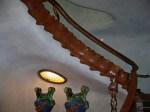
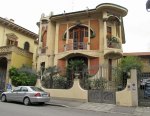
Now, you may still be wondering what this has to do with Florence.  I’ll tell you.  There is a house down the street which looks nothing like any other houses in the neighborhood (or any neighborhood in Italy); it looks, well, curvy and organic and a little surreal.  In a nutshell – it looks like the architect channeled Gaudí!  Steve and I both thought so the minute we saw it.  Now here’s a funny side note – we had dinner guests over one night and they started describing this amazing house they had seen on the walk over – we both immediately blurted out “the Gaudí house”!  They weren’t familiar with Gaudí, so we had the pleasure of filling them in and lending them a book about him.  (So, that is how we get to Gaudí from Florence).   The final row of pictures are of the house down the street – ending with a close-crop of one of the weird little webbed creatures that adorn the top (I’ve since learned the house is called Villino Broggi-Caraceni, built in 1910, not by Gaudí).  Enjoy!

A Tale of a Good Day (Complete with mini-tour of Bargello)

Ciao Readers!

I have shared with you many stories of woe and culture shock, so today I thought I’d share a tale of a very good day.  To me, this was yesterday; but since I have already written about 2 weeks worth of blog posts, to you it was probably a couple of weeks ago. (Lucky for you you’re not reading about actual yesterday (Dec. 4), or you’d be reading about my being wet and cold and homesick and about my wait at the post office.)  In any case….

The day started off with a necessary trip to the Questura (where you do most immigration-related things).  Now, you’re probably thinking “that doesn’t sound like the start of a good day” – but the sun was out for the 35 minute walk there and the lines were faster than usual, with the lady who’s helping me already through by the time I got there (yay!).  With so much of the beautiful morning left (this was a Friday; I don’t have school on Fridays), I decided to just stroll.

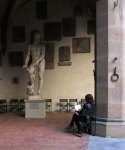
Somewhere during my leisurely stroll I came upon the Bargello (lesser known museum); with my Uffizi card in hand, I walked right in (love this card!).  While I’ll provide the educational tour part below, the Bargello was also cool for two reasons other than the art – 1) it was almost empty and soooooo quiet and peaceful – I sat in the courtyard and relaxed (and watched the woman pictured below sketching one of the sculptures) and 2) I bumped into one of the women from the charity organization meeting I had attended and it made me feel like this is really my town (bumping into acquaintances has that effect).

After the Bargello I decided to stroll around “my town” some more, soon realizing I was less than a mile from Steve’s school and it was almost his lunch break; we met on the hill and sat in the sun for a bit – nice!   After Steve got home from work we decided to fight the urge to be lazy and go out for (yet another) stroll.  First, to see if a Korean grocery store my new Italian teacher (she’s originally from Mexico and now studying Korean!) told me about really exists (it does – tiny but cool).  At this point Steve needed to find a restroom, and as you may or may not know, this isn’t the easiest task anywhere in Europe and usually involves paying for the privilege.  Since we were close to the Uffizi and I was thinking they might still be open (about 5:30 p.m.) and we have that card that gets us in for free, we checked it out – at first we thought they were closed because it was deserted, but the sign said “aperto” and in we went (good tip for visiting the Uffizi sans crowds)!  So, how amazing/surreal is this – I waited for Steve in front of Botticelli’s “Birth of Venus”!?!?!   Seriously – taking a bathroom break in the building with some of the world’s masterpieces?!?!?!  Unreal.  In any case, we still had an hour before the museum closed, so we strolled around and appreciated the museum.

By this time we were getting hungry, but being Italy it was still about 1 – 1.5 hours too early to think about dinner…but NOT too early to think about the aperitivo buffet at Serafini (which I wrote about and posted photos of here)!   We had a lovely time at the aperitivo, and not having stuffed ourselves on what was not meant to be dinner, stopped by our favorite pizza place (which opens at 7:30) and got a margherita pizza to go.   All in all, it was a very good day!

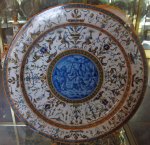
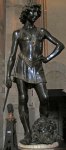
As for the Bargello, it is a sculpture museum, which used to be a prison.  As I mentioned, the courtyard (row 1) is very peaceful (I didn’t know until researching later that they used to execute prisoners here – gasp!).  The museum has a few lesser-known pieces by Michelangelo and (almost) an entire room dedicated to Donatello.  There are also lots of tiny sculpted works such as vessels and combs and more.  Photos are prohibited, but now I’ve learned in the less-populated rooms, if you ask nicely they sometimes let you take a no-flash shot (much better approach than when I did so without permission in a different gallery and promptly got yelled at and kicked out of that room).   So, below, following the courtyard shots, are a few more shots throughout the upper rooms (notice the cool grotesques on the plate), ending with Donatello’s “David” as well as another artist’s (Verrocchio’s) version of David (seems like they had a contest as to who could make David look the “least intimidating,” no?).

It was a lovely stroll (I google-mapped as much of it as I can remember and in total I walked about 10 miles) – thanks for coming along!

Street Sign Art in Florence

Ciao Readers!

Just in case you were beginning to think (as I was) that all of the art in this city was created pre-1600, today’s post is for you!

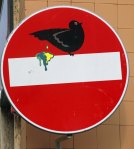
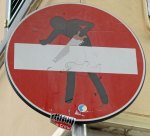
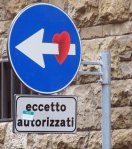
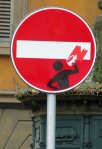
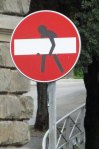
One day when I was on a tour with my old school, one of the other students pointed to a street sign and asked our teacher about it.  He thought she was pointing at a very old cross on a historical building and thus gave us a 5 minute lecture on its history.  However, what she was really asking about was street sign art (non-sanctioned, “guerrilla”) by “Clet.”  (When she re-pointed and asked the teacher again he just shrugged with disinterest and continued our tour).

Since that day I have learned that Clet is pretty famous here and I have even seen t-shirts with images of his signs.  Clet Abraham is a French artist who has been living in Florence for years and creates his street sign art by applying adhesives to the signs.  He has apparently been fined many times for his creations (but I am guessing the t-shirt sales and publicity cover the fines).  Whenever I see one of his signs in town (and I have remembered my camera) I stop and take a picture.  I know there are several other versions out there I have missed, but below are a sampling of some of the ones you can find all over town (they are repeated throughout the city).  You can find more information here and photos of many other signs here.

Fun stuff!